Sunday, February 05, 2023

Jewish survivor of Holocaust: "If I survive, I will paint."

Z,

Thank you.

We must all tell the story in our own ways.

In July I had exhibition of poetry and my B and W portraits incld of Zelensky.

Yesterday I drew 17 year old Spider killed in Sagaing.

Akhmatova was asked in line in prison if she could describe this--

she nodded.

Best

aunty km


Dear All, A New York Times obituary of a Czech Jewish survivor  of 4 SS-run camps including Auschwitz.   Over the last 20 years since my  German friend took me on a visit to Dachau, the very first Nazi concentration camp on the outskirt of Munich, Bavaria, I have visited half dozen infamous camps in specifically Poland and Germany, including the most horrid place Auschwitz. The sight of chimneys, crematoriums, gas chambers, mass graves, as well as the victims' barracks get etched into one's memory.  The rage against the uncaring states ("state actors", so-called) -- God forbids that states adopt kindness and compassion, if you ask Mr Kissinger for wisdom of his statecraft! -- ,  and the acute pain of hearing from the museum guides the heart-wrenching tales of the SS victims' subhuman existence,  witnessing the physical conditions of their barracks and works , the sight of furnaces, electrified barbed wire fences, the sight of descendants of the perished victims and survivors in these vast killing fields in Germany and Poland are typical and recurring sensations I have felt every time I step into the compound of these museums.  This obituary resonates with me.    Every time I hear the word The Shoah or the Nazi genocide of the Jews I can't help but make a sad and rage-filled link between it and the present day Israel - the officially Jewish State with echoes of the ideology that served as the foundation of Nazi Germany.     It is, i am so painfully aware, that a highly morally  hazardous act to draw a comparison between Far Right Israel of 2023 which has as a matter of policy kept barely alive a few million Palestinians in the vast open prison called West Bank and Gaza, and the Nazi policies.   I have seen with my own eyes the triumphant display of Israeli flag by young Israeli visitors on a state-supported tour of Auschwitz (and other death camps) who wrap themselves in the flag while posing for selfies on the train tracks at the Death Entrance of Auschwitz.   I fail to understand via rationality why a population that has suffered so much systematic persecution  - and even attempted extermination - in both the Christiandom of the Old Europe    and the Enlightened Europe of Science and Renaissance have become so racist, so hateful, so vile and so inhuman towards the native population of Palestine - the Arabs of Palestine.    The rhetoric of "we have been here for 3,000 years" - often straight from the mouths of the Jewish Americans who emigrated from Brooklyn, New York is hardly any justification, intellectually or morally, for the heinous policies and acts of The Jewish State.    I stopped dialoguing with any Jewish friends of mine whose "Israel, Right or Wrong" stance forecloses any possibility of a meaningful dialogue over the subject.  Over the years,  I have lost quite a few friends and colleagues who assume that irrational attachment to something which is not exclusively theirs.     One day after the Soviets' liberation of Auschwitz - 27 Jan. - I found myself sitting in an airport cafe with two young Israeli women - in their mid-20's, my older daughter's age really - as we were all waiting for our flights to Bangkok on 2 different airlines.    They identified themselves as recently discharged IDF officers - one served for 4 years as a commander trainer and the other, an IDF spokesperson and news producer.  One identified herself as being on the Left, and the other , on the Right.  They were travelling together as friends.  I held my views of Israel to myself and I let them speak about their experiences, observations of their country's situation.    I enquired about the peace movement among Israelis.   The ex-spokeperson of IDF tensed up, and answered, "We live in peace.  IDF protects us", only to contradict herself in the course of the 30 minute conversation:  "they killed 7 people (Israeli) yesterday at a synagogue which was 2 minutes away from where I used to live)."   She went on to say that, "Israel has no partner for peace" among the Palestinians. She called Palestinians and their orhanizations "terrorists".    She insisted that Israel is "secular and modern".  And that all these international accusations of Israel being racist/apartheid or demolishing of homes of "terrorists" nothing but "smear".   The other ex-commander with her less fluent English chimed in occasionally, using her smart phone to translate her Hebrew expressions into English.   I asked if they were aware that Likud Party had terrorist origin and the founding father David Ben-Gurion would order his men to line up scores of original residents of Palestinian villages and mass-execute them - with the purpose of terrorising the Arab inhabitants from ever returning to their places of origin.   Of course, their indoctrination as Israeli or IDF officers did not correspond to or was not  based on verified historical facts.    One of the two had vacationed in my wretched racist land of Myanmar, and she raved about her beauty and loveliness of Burmese people, my people.   I interjected and said, "we call ourselves Buddhists and we perpetrated genocide against Muslim Rohingya."   But, alas, none of my words of facts registered with the one who spent 3 weeks in Myanmar.    She wanted to keep her traveller's memory of Myanmar as a "wonderful" tourist paradise.  The word genocide obviously did not mean anything to her - 1  day after the anniversary of Auschwitz liberation.    I was not disappointed by the complete Zombie-like character of our chance conversation.    I just felt despair and pain - that a people who sufferings have been so well-remembered, memorialized and commemorated and a state that has more than implicitly justified its really diabolical and violent nature of foundation have shown absolutely no humanity towards the sufferings of other fellow human populations.     David Reiff, the son of the late Susan Sontag and the famed  scholar of humanitarian industry, was actually right when he said, "Never again!" simply means never again shall the Jewish people be subject to genocide in Europe.  But this indifference to human suffering is not exclusive to Israel.    Much of Asia were sites of genocides, legally recognized or not.   Asians and Asia are doing no better      What a sad civilization!!      Have a good day!   Zarni p.s.  today is the  5th anniversary of my historian and educator mother's passing.   So, I am including a quick note of remembrance on the special day , for me.

https://www.nytimes.com/2023/02/04/arts/fred-terna-dead.html?algo=reverse-chron&block=1&campaign_id=142&emc=edit_fory_20230205&fellback=false&imp_id=667878107&instance_id=84576&nl=for-you&nlid=62429399&rank=3&regi_id=62429399&req_id=976826645&segment_id=124474&surface=for-you-email-wym&user_id=efa950df3d8c903656f63e9bf53dadc8&variant=holdout_fye_wym      

Fred Terna, Creator of Fiery Holocaust Paintings, Dies at 99

A prisoner at Auschwitz and three other camps, he dealt with his trauma in semiabstract art that depicted crematories, ovens and chimneys.
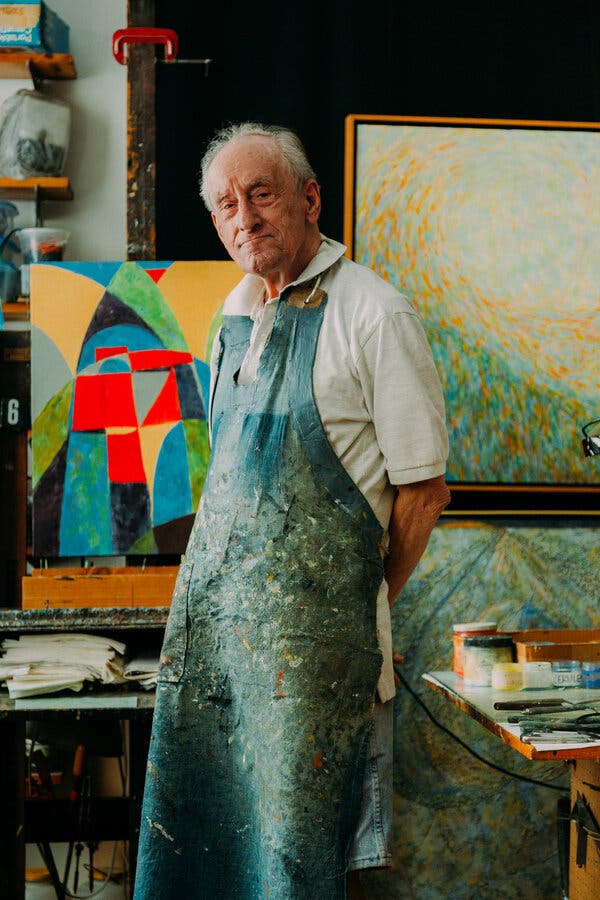



Fred Terna wearing a long blue smock with paint stains over a white shirt. His hands are behind him and he is looking at the camera. Behind him are several colorful paintings.
The artist Fred Terna in his Brooklyn studio in 2015. “How does one paint the near certainty of violent personal annihilation?” he once asked.Credit...Daniel Terna
Fred Terna wearing a long blue smock with paint stains over a white shirt. His hands are behind him and he is looking at the camera. Behind him are several colorful paintings.
Feb. 4, 2023

Fred Terna, an artist who tried to exorcise the psychological trauma of his imprisonment in four Nazi concentration and labor camps with semiabstract paintings that depict fire, ashes and chimneys, died on Dec. 8 in Brooklyn. He was 99.

His son, Daniel, confirmed the death, which was not widely reported.

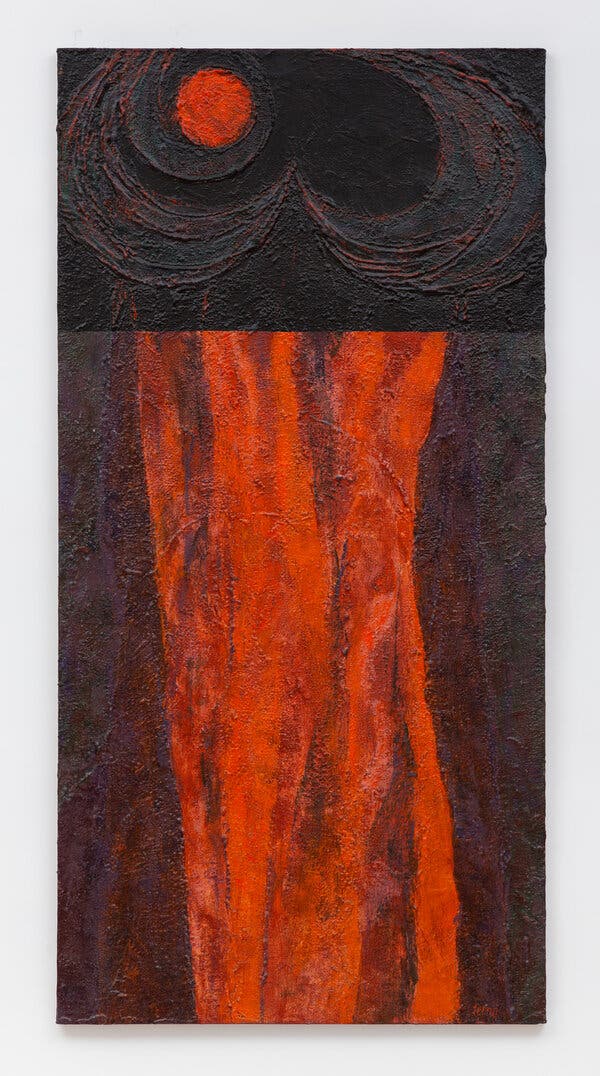
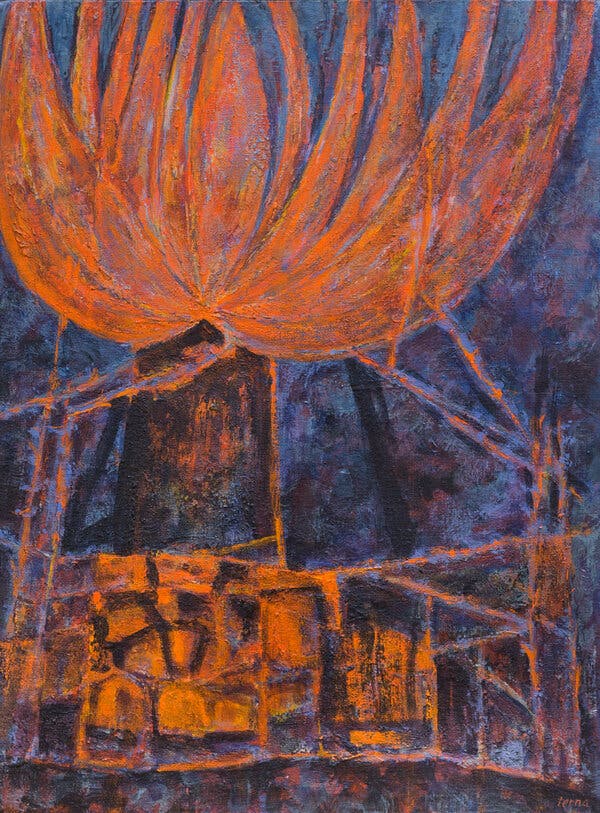
Mr. Terna’s art became his Holocaust testimony. In acrylic works like “In the Likeness of Fire” and “An Echo of Cinders,” he painted in reds, yellows, oranges and blues to illustrate the flames that incinerated Jews in crematories. In some paintings, he used sand pebbles to represent ashes.

“I know how the fire of a crematorium chimney casts flickering light on a barrack wall,” he wrote in 1984 for the Berman Archive at Stanford University, which documents American Jewish communities. “How does one paint the near certainty of violent personal annihilation? How does one paint, and then make a viewer want to stop, to look at a canvas, to react to it?”

He added, “As there are fewer and fewer of us, I feel the increasing weight of the promise we made to each other in Auschwitz, in Dachau and in so many other places:

“If I survive, I will tell what it was like. I paint.”
Image
A painting showing a long streak of red topped with outlines of circles, one of which is filled with more red paint.
Mr. Terna’s “Ascent in Fire” (2003). “I’d call his work representing the Holocaust beautiful even if the imagery is not beautiful,” one curator said.Credit...Fred Terna
A painting showing a long streak of red topped with outlines of circles, one of which is filled with more red paint.

“An Absence in the Fire” suggests an open door into an oven, in which a figure appears to be aflame. “Lasting Drift,” painted mostly in shades of black and blue, shows a chimney belching smoke, with small sticks in the foreground that represent bones.

“I’d call his work representing the Holocaust beautiful even if the imagery is not beautiful,” Suzy Snyder, a curator at the United States Holocaust Memorial Museum, to which Mr. Terna donated two dozen works, said in a video interview. In the same interview, Fred Wasserman, another curator, said, “I don’t think his work looks like anything else in our collection.”

Daniel Terna said that even when his father’s work was lighthearted, his paintings still evoked fire. “With greens and blues,” he said by phone, “the form of flames was still there.”
Image
A painting with a deep bluish background and orange paint in the shape of flames, topping a dark rectangle, with geometric orange shapes at the bottom.
“In the Likeness of Fire” (1983).Credit...Fred Terna
A painting with a deep bluish background and orange paint in the shape of flames, topping a dark rectangle, with geometric orange shapes at the bottom.

Writing in Bomb magazine in 2016, the critic Stephen Westfall noted that one of Mr. Terna’s paintings depicts what looks like a white snow patch or pond surrounded by light brown earth. But, he wrote, “The image actually derives from a snow-covered pit of corpses.”

The anger that Mr. Terna felt at the war in Ukraine led him to create another flame-themed painting last year. “Putin’s moves just triggered that in him,” his son said.

Bedrich Arthur Taussig was born on Oct. 8, 1923, to a Czech family in Vienna. His father, Jochanan, known as Jan, worked in the maritime insurance business. His mother, Lona (Herzog) Taussig, was a homemaker.

Fred, his parents and his younger brother, Tommy, soon moved to Prague, where Fred’s mother died of pneumonia in 1932. With the threat of Nazism growing, Fred’s father changed the family name to Terna to sound less Jewish.

But the Ternas were not safe. After the German invasion of the Czech provinces of Bohemia and Moravia on March 15, 1939, Fred was expelled from high school in Prague because he was Jewish. His father sent him into hiding to a farm outside Prague, where he stayed until the fall of 1941.

But when the Gestapo learned he was there, he was sent to the Lipa labor camp in Prague; after two years, he was moved to Theresienstadt, also in Czechoslovakia, which was a ghetto as well as a transit, labor and concentration camp. His father and his girlfriend from Prague, Stella Horner, were also there.

Image
A canvas of dark colors, with red at the top, blue in the center and black at the bottom. a faded rectangle is visible toward the left.
Mr. Terna’s “Lasting Drift” (2015) shows a chimney belching smoke.Credit...Fred Terna
A canvas of dark colors, with red at the top, blue in the center and black at the bottom. a faded rectangle is visible toward the left.

Although he was untrained, Mr. Terna began to draw at Theresienstadt and became part of a group of artists there who scrounged for good paper and any raw material they could turn into ink. He buried his sketches of everyday life there in a tin box under the barracks floor.

Before being deported to Auschwitz in September 1944, Mr. Terna gave his drawings of everyday events, like people lining up for soup, to another prisoner, believing he would never see them again. He had spent only two months in Auschwitz when he was deported to Kaufering, a subcamp of Dachau. After an unsuccessful escape attempt, he was liberated by American troops on April 27, 1945.

Sick and weighing only 70 pounds, he convalesced at a hospital, where he began painting scenes from Auschwitz, as well as landscapes.

“Much later, looking at my landscapes I noticed that there were walls and fences in many of them,” he was quoted as saying by the Defiant Requiem Foundation, which honors the prisoners of Theresienstadt. “It taught me that the memory of the Shoah was a part of me, and that it would not go away, and that I would have to live with it.”

His father died in Auschwitz, and his brother died in the Treblinka extermination camp.

After returning to Prague, Mr. Terna reunited with Stella Horner, his girlfriend. They married in 1946 and moved to Paris, where he studied art and worked as a bookkeeper for the Joint Distribution Committee, a Jewish relief agency. They left for Canada in 1951 and later moved to Manhattan. (They would divorce in 1975.)

ADVERTISEMEN

Mr. Terna was not part of the Abstract Expressionist movement that had taken hold after the war, but he adapted it to his artistic vision, particularly in his use of sand and pebbles to create texture in his canvases. In addition to his Holocaust art, which he began in the 1980s, he painted circles as symbols of life’s continuity and representational pieces depicting angels and biblical stories like that of Abraham and Isaac.
Image
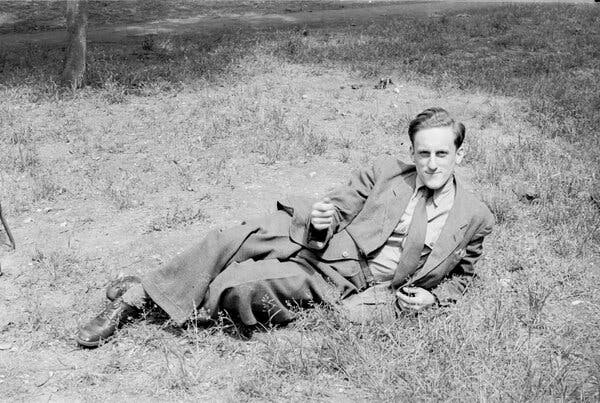
Mr. Terna as a younger man wearing a suit and tie and lying in a grassy field while propping himself up on one elbow and looking at the camera.
Mr. Terna in 1946. He began to draw when he was a prisoner at Theresienstadt, and he buried his sketches in a tin box under the barracks floor.Credit...via Daniel Terna
Mr. Terna as a younger man wearing a suit and tie and lying in a grassy field while propping himself up on one elbow and looking at the camera.

He never became famous, but he made a living as an artist, with occasional freelance jobs like designing wallpaper. “He sold his paintings at frame shops, to people in the neighborhood, to therapists looking for paintings in their offices,” Daniel Terna said.

In addition to his son, Mr. Terna is survived by his wife, Rebecca Shiffman, a child of Holocaust survivors, with whom he lived in Brooklyn.

After he and Dr. Shiffman, the director of maternal fetal medicine at Woodhull Hospital in Brooklyn, married in 1982, they spent their honeymoon in Israel and visited a kibbutz that had a museum dedicated to the memory of victims of Theresienstadt.

Mr. Terna had been searching in libraries and archives for his drawings, which he had not signed because he did not want to be identified.

In 2017, in an email to a German researcher, he recalled his thoughts before visiting the museum: “If any of my work survived, it probably is ascribed to another artist. If that was the case, I would be satisfied. The record is more important than the originator.”

The record, at least a small part of it, had survived.

“The curator did not know specifically what was in storage, but allowed Fred and Rebecca to look through the boxes,” Julia Mayer wrote in “Painting Resilience: The Life and Art of Fred Terna” (2020). “In the middle of a file of unidentified art, they found six of Fred’s works.”

Richard Sandomir is an obituaries writer. He previously wrote about sports media and sports business. He is also the author of several books, including “The Pride of the Yankees: Lou Gehrig, Gary Cooper and the Making of a Classic.” @RichSandomir


Chin people of NW Burma sing--We are the world-- to draw attention to current atrocities by junta.

We are the world - ချင်းအဆိုတော်များ We Are The World Cover By CHINLUNG CHUAK ARTIST What a lovely song, performed by our Chin brothers and sisters all over the world. We'd like to thank ChinTube for bringing together the best singers to make this happen. CHINLUNG CHHUAK ARTIST: Atea PB (Boomarang) Benjamin Lianpi Benjamin Sum (Guys From Chin) Betty Mang Hlei Tial Biak Hlei Par David Lai (Guys From Chin) Emily Ngung Hlei Sung G'nie Henry Varte Honey Khuaitizu Jenevy Sui Lian Lian Liandingpuii P Thawngbawi (Guys From Chin) Rebecca Lallawmsangi Rema (To Coda) Sangtei Khuptong Shinbia Van Hlei Sung Vari Varte Yellow Muzik Zoramchhani Zorema Khiangte and To Coda Band Youtube link: https://youtu.be/2ky1Wa7qclg

They also have a beautiful dance troupe, as do the Karen/Kayin people.

2-5-2023


Chinese spy balloon shot down over Carolinas--

https://www.cnn.com/politics/live-news/china-spy-balloon-us-latest-02-05-23/index.html

Saturday, February 04, 2023

Interview by Garfunkel + My Ph.D. dissertation + my Asian Survey article +


"I was just saying, among all those who came to work with us, you were the best and the brightest."

Thank you for that opportunity.  It was life-changing.

Dr Sein Win is the son of U Ba Win, brother of Bogyoke Aung San, (Daw Aung San Suu Kyi's father and founder of modern Burma.)

Both brothers were killed in the mass assassination just before Burma obtained Independence from Great Britain.

We should take time to remember their Sacrifice and try to make things better, no matter how grim things are today.

After all, we only have one life each, not nine as cats are supposed to have, maybe because they handle falls so well.

Kyi May Kaung (Ph.D.)

2-4-2023


Just read everything by Ngugi Wa Thiong'o--Amazing--the writing as well as the life--


Also read, Alan Paton, Cry the Beloved Country.

Wole Soyinka --Nobel Laureate--Death and the King's Horseman.

I was so fortunate to see this play and meet Soyinka.

2-4-2023


Hit French novel from point of view of Putin


A previous one by Jennifer Ciardi is called I, Putin

set during Kurst submarine disaster where all died.

Due to P not accepting Wn aid.  There is another book which is more detailed about Kurst disaster, non-fiction, not by Ciardi.

Very sad.

2-4-2023


Friday, February 03, 2023

Chinese balloon--Blinkin cancels trip


2-3-2023


LA Brea Tar Pits L.A.

https://www.msn.com/en-us/travel/tripideas/the-la-brea-tar-pits-have-revealed-ice-age-relics-dating-back-50-000-years/ar-AA172EDD?ocid=winp0dash&pc=WSPWWU&cvid=374a8457562d4cd39c3d5f1001232d1a

My Take--what they are doing now

"Cleaning the Augean Stables" was a favorite of Aung Gyi during the first caretaker gov. in Burma, of course depicting themselves as Hercules.

Time has shown they are wrong.  At that time they closed visas to one or two weeks each.

Now they are closing passport offices so people can't leave.

The power holders have withdrawn to their "last fortress" NPT.

Martial law is imposed on 37 villages in Resistance Strongholds.

Once country is closed off, they will step up air strikes even further.

Both sides are in do or die mode.

The sad thing is many people will die horrible deaths.

--   2-3-2023


Augean stable most often appears in the phrase "clean the Augean stable," which usually means "clear away corruption" or "perform a large and unpleasant task that has long called for attention." Augeas, the mythical king of Elis, kept great stables that held 3,000 oxen and had not been cleaned for thirty years - until ...

Augean stable Definition & Meaning - Merriam-Webster


Obit--Lovely Aunty Dora (Ma Than E Fend)


Daw Than E or Ma Than E Fend, as she called herself (Daw is the Ms. prefix for mature women, Ma is more like Miss, Fend was her married name), popular singer known in the 1930s as Beelat Pyan Than, “Than who returned from England” died June 17th at a retirement home in Oxford, UK.  She was 99 and friends were looking forward to celebrating her 100th birthday in February, 2008.

Daw Than E was a close family friend of Burmese democracy leader Daw Aung San Suu Kyi, Suu’s parents, Bogyoke Aung San and Daw Khin Kyi, and Suu’s late husband Michael Aris, as well as her sons Alexander and Kim.  Living as she did for so long a period of time, her friendships spanned at least three generations.  She saw a lot of Burmese political history first hand, almost from the eye of the storm, as part of and close to the Burmese intellectual elite. 

Herself.

I grew up on scratchy 78 rpm records played on a His Master’s Voice player that had to be cranked by hand.  Among these was Daw Than E singing her songs in Burmese to the tune of English popular music of the time.  Then when I was about 10, I met the owner of the famous voice herself, when she came to visit Burma, about twice, from her job at the U.N. in New York.  When she visited, Aunty Dora was an ebullient presence, very glamorous, who one time flipped up her jacket at the waist to show us her bare

midriff, that she was wearing a bra.  Before that Burmese women wore full bodices that came down to their waists, under their (at one time transparent “glass nylon”) jackets.  What I liked about Aunty Ma Than E was her jackets were translucent, not transparent and she spoke directly at you, not in a condescending manner or patting your head in a patronizing way, but looking at you as at an equal, even if you were only 10 at the time.  We did not see her often, being as it was that she had to fly from America on Pan Am – air travel was not as convenient nor safe as it is now.  Another friend of my parents, an American woman, died in a plane crash; another couple was in a hijacked plane.  I only saw her briefly twice in Burma.  I got the impression she was more my father’s friend than my mother’s.   After her second visit, we learned she was getting married, to a gentleman 20 years younger who also worked at the U.N.  She was at the time in her 50s, which in Rangoon society sounded scandalously old. 

After my father died we did not see her any more, but my mother often said that if father had not died, he might have gone to work at UNESCO in Paris.  Daw Than E had brought application forms already.  But at the time, I remember mother saying she didn’t want to live in Paris, it was “such a fleshpot of a city, full of vices.”

Years always overseas.

Daw Than E lived almost her whole adult life overseas, working for All India Radio as well as the U.N., where she also had a radio job, I found out later.  In her essay in Suu Kyi’s Freedom from Fear, she described her work for All India Radio during World War II as broadcasting to territories under Japanese Occupation, which included Burma.  After the war, she went to San Francisco and worked on the same

broadcasting assignment for The U.S. Office of War Information, now the VOA.

She describes 4 years in Algiers, transferred from New Dehli’s U.N. Information Center, to establish such a center in newly independent Algeria.  The more I find out about Daw Than E, the more she fits my role model of the “thoroughly modern Burmese woman”, well educated, worldly, able to work shoulder to shoulder with the men, exemplary in dress and comportment.  She describes Aung San Suu Kyi in almost the same terms in her essay.

*

I thought in later years that Aunty Dora was like the Irish poet William Butler Yeats’ great love, Maud Gonne, who always lived away from Ireland in France, and always declined Yeats’ offers of marriage.  Gonne even got married to someone else and had a child, after which Yeats tired of asking her, and asked her daughter, who also declined his offer of marriage.

Ties with the Aung San Family.

In the first and second edition (1996) of Freedom from Fear, Daw Than E wrote an informative and affectionate portrait of Suu, going back to her first contacts with the family.  She wrote that she met up with General (Bogyoke) Aung San and his entourage in London in January 1947, when he was there to discuss Burma’s Independence with the Atlee government.  The war had just ended and it was cold, there was no central heating and food was still rationed in London.  We see Aung San as he was in his great coat with the collar spreading like wings.  Aung San wanted to meet all the Burmese in London and the dinner was at the famous Dorchestor Hotel, where the rich and famous such as Liz Taylor have stayed.  Daw Than E wrote of how she bought gifts for the family at Aung San’s request, including a doll for Suu Kyi.  A few months later he and his entire cabinet would be dead, victims of a mass assassination attempt that killed 8 others, on 19th July 1947, now known as Martyr’s Day.

Daw Than E attributes all the shining qualities we find in Daw Suu, to the example of her parents and the stellar education her mother Daw Khin Kyi was able to give her, as a single mother and widow, and Burmese Ambassador to India.  Suu Kyi visited Daw Than E when she was in Algiers, and she describes Suu’s summer spent reading, traveling and doing volunteer work.  Clearly, to use Daw Than E’s words, the chrysalis was preparing to emerge.

Ties with Suu herself.

During the time that Suu Kyi worked 3 years at the U.N. she stayed in Aunty Daw Than E’s apartment in Manhatten.  Daw Than E describes a particular incident at the house of U.N. Burma Representative U Soe Tin’s house, which I want to quote in some detail because it shows the ugly side of the military government which had come into power in 1962 and has been in power since, under different names.  The incident also shows Suu’s grace under pressure, not to say being revealing some of Daw Than E’s political ideas – which Daw Than E did not talk about overtly.

Invitations from U Soe Tin .  .  . were a little different.  .  .  .  He was a liberal type who did not divide us into sheep and goats.  The goats were those suspected of being critical of what was happening in Burma during the Ne Win regime. 


She then goes on to describe the unpleasant experience.


The large living room (with) an excess of black and gold Burmese lacquer had been re-arranged so that sofas and chairs were against the walls –

On those sofas and chairs was ranged a whole battery of Burmese ambassadors attending the current General Assembly.

.  .  .

U Soe Tin was smiling politely but looking uneasy.  .  .  .  the company was preparing to sit in judgement on Suu.  But for what?  .  .  .  The chief delegate led the attack.  How was it that Suu was working for the U.N.  What passport was she using?  (and so on).


The whole company listened to this tirade with a sort of sycophantic deference, turning their eyes on Suu and murmuring agreement.  Suu’s calm and composure were very reassuring.  She replied with great dignity and in very quiet tones.


.  .  .  She was sure all the uncles in the room would understand.   .  .  .


These were Suu’s elders, but not necessarily her betters, I thought.”


Herself again.

In the years I was not in touch with her, I saw Daw Than E’s photograph once.  She looked just as beautiful, if not more so.  The friend who brought the photographs to “show and tell” to the office, said, “Well, she has good cheekbones.”

When I came to the United States on a Fulbright, I linked up again with friends of my childhood, and Princess Sao Ying Sita of Yawngwe gave me Aunty Ma Than E’s address in Feldkirch, Austria.  She had gone there to live, in this small town in the Alps, with her husband after retiring from the U.N.  As she handed me the small slip of paper with the address on it, Ying said in her usual brusque manner, “If you are going to contact her, don’t procrastinate, do it fast.  She’s about 100 years old.”

“She doesn’t like to be called ‘Aunty Dora’” Ying said.  I asked why, but Ying had no answer.  I’ve noticed since that friends from those days, now settled in the West, don’t like to be called by those names, but by their Burmese names.  I don’t know why. 

“What should I call her then?”

*

Now I know she was not a hundred then, only about 80. 

This was the start of a delightful correspondence, me writing to her on blue air letters and she writing back on proper notepaper in an envelope.  I always experienced a feeling of joy when I recognized her sloping handwriting, what used to be called “a good hand.”  One time she sent me a Christmas card she had made herself, with a photograph of roses in a glass vase she had taken herself.  It wasn’t that the letters were long, chatty or gossipy.  They were in fact, quite reserved.  Nor did she talk of politics.  Nor did she gossip about others.  I concluded that despite the racy image most people seemed to have of her, Aunty Ma Than E was in fact quite the Victorian to suit the age, before World War II, when she had grown up in colonial Burma under the British.  She never spoke about her own personal life, nor mentioned her husband.  I tried coaxing her into talking about all the people she had known in Burma in the 30s.  Her reply was a model of propriety and goodwill.  When my mother died I wrote to tell her about it.  She said she remembered my mother as the loving wife and mother that she was.

All Aunty Ma Than E’s letters were one or two paragraphs long.  They were all in English.  Her thoughts were always clear and her handwriting always firm.  I’ve kept

all of them. 

When I was desperately searching for a job after obtaining my doctorate, Aunty Ma Than E said she too, had not been able to figure out what to do before she got the U.N. job.  I asked her in 1997 for an interview for radio and a recent photo.  She declined the interview, but sent a photo of herself with a scarf around her head, tied at her chin, against a backdrop of the Alps.  She looked about age 35, younger than she looked in the first Freedom from Fear edition, where there’s a picture of her and Suu in Algiers, and a portrait of her from the 1930s by Sir Gerald Kelly.

When Prof. Michael Aris died in 2000, Daw Than E sent me a copy of the memorial program in the mail.  The management at the radio station where I worked was inexplicably saying “No obits,” but I made and broadcast an obit with sound bites from about ten people anyway.  Daw Than E asked for her program back, so I quickly made a Xerox copy and posted the original back to her.

A lovely phone conversation.

In 2001, Daw Than E made an amazing relocation.  At this advanced age, when she was already in her 90s, she moved, not to the house next door, but to a retirement home in Oxford, UK, from Austria.  Fortunately, I learned of her move and received her new address, typed on a tiny slip of paper as the fortunes in fortune cookies in Chinese restaurants.  When I remarked about the remarkable move, Aunty was quite blasé.  She said it took some planning, especially the financial side.

In the 90s, I had tried calling her in Feldkirch once, but she was out and I did not understand her answering machine message, which was in German.  In 2003, I was in London in connection with my work and research, and had the chance to call her.

“Herself,” she said sharply into the phone when she picked it up.  She knew at once who I was when I said “Kyi Kyi.”  She had told me earlier in a letter that these days, “like all elderly people, I sleep a lot.”  But she was very alert when I called her.  With my feet propped against the wall while I sat on my bed in my hotel room, I listened mostly as she told me where to send articles I wrote about Burma.  She then said thoughtfully, “It’s good you are traveling while you can.” 

“If you are walking in the concourse at the airport and your bag feels so heavy, I’ll tell you what to do –“

“What, Aunty?”

“Look for a young man and ask him to help you.”

“Good idea, “ I say, laughing.

“If you are walking and your feet hurt and you can’t walk any more –“

“I know, I know,” I interrupt impatiently, “Look for a young man, right?”

“No!” she says, so sharply I almost jump off the bed.

“What then, I don’t know what I should look for?”

I am genuinely nonplussed.

“Look for a cart!”

I almost die laughing.

*


Well-known Burmese dissident, now turned anti-sanctions advocate and constructive engage-ist Dr. Zarni, once said, as if as an afterthought, “What people discount is love.”  It seems to me Daw Than E’s life shows an exemplary abundance of love, in the subliminal sense of Buddhist metta, often translated as Loving Kindness.  Such longevity presupposes the sense of knowing how to live well.  “At least do no harm,” as someone once said of hospitals.

A mutual friend, also the age of a nephew of Daw Than E said, “She has no known living relatives on her side.”  She always did, however, tell me how much her Austrian in laws had helped her.  I don’t know anything about her religious beliefs, as she never wrote nor talked to me about religion.  And it does not really matter. 

*

Dear Aunty Ma Than E, we will all follow you one day on life’s last journey.  The important thing is that we live according to our beliefs and by our own lights. 

--- KMK 6-18-07

First published in Mizzima.

Daw Than E's wikipedia page.


https://en.wikipedia.org/wiki/Than_E

Accessed 7-1-2015

Youtube--Daw Than E singing 2 songs--https://www.youtube.com/watch?v=wa9uWuVFUN8


the lyrics were much better in these 1950s songs, or maybe they were from before the War.


KMKaung

7-1-2015

Thursday, February 02, 2023

Digital collage--Remember Jimmy--


composed of 2000 + photos of people killed by junta.

To share, post this link only--copy and paste on ye social media

DO NOT FWD

do not include my name and email address

thanks

2-2-2023


They flipped the monk + Poem by Yevgeny Kronstadt


Good monk, bad monk.

monks on catwalk like models

monks with private militias

monks who snatch the envelope out of your hands

monks who say $700 is "too little"

Monks with a 4 star hotel/monastery in Alabama,

denying donations from democracy supporters.

This guy with a monastery in Moscow, Russia.

Not the "moscow"=burmese prison.

This guy + wirathu to sri lanka to study

TAMIL GENOCIDE.

Hearing a lot these days, junta suicide.

Wait.

Wait without hope.

yevgeny kronstadt.

2-2-2023


From Irrawaddy--on anniv of min aung hlaing coup--TWO BLOOD Soaked years


read the news

don't live in yr crony bubbles--bubbles burst quickly.

2-2-2023


BBC--Jonathan Head--graphic--children among dead--airstrikes by myanmar junta--data at end--Russian Belarus planes, helicopters

https://www.bbc.com/news/world-asia-64397397 


Do Something.

Man shot in Butler, PA during Trump assassination attempt dies--

https://apnews.com/article/james-copenhaver-trump-rally-butler-dies-00866b37ad8db967b4ebf6582c756bcd?utm_source=firefox-newtab-en-us